Mehak
Mehak 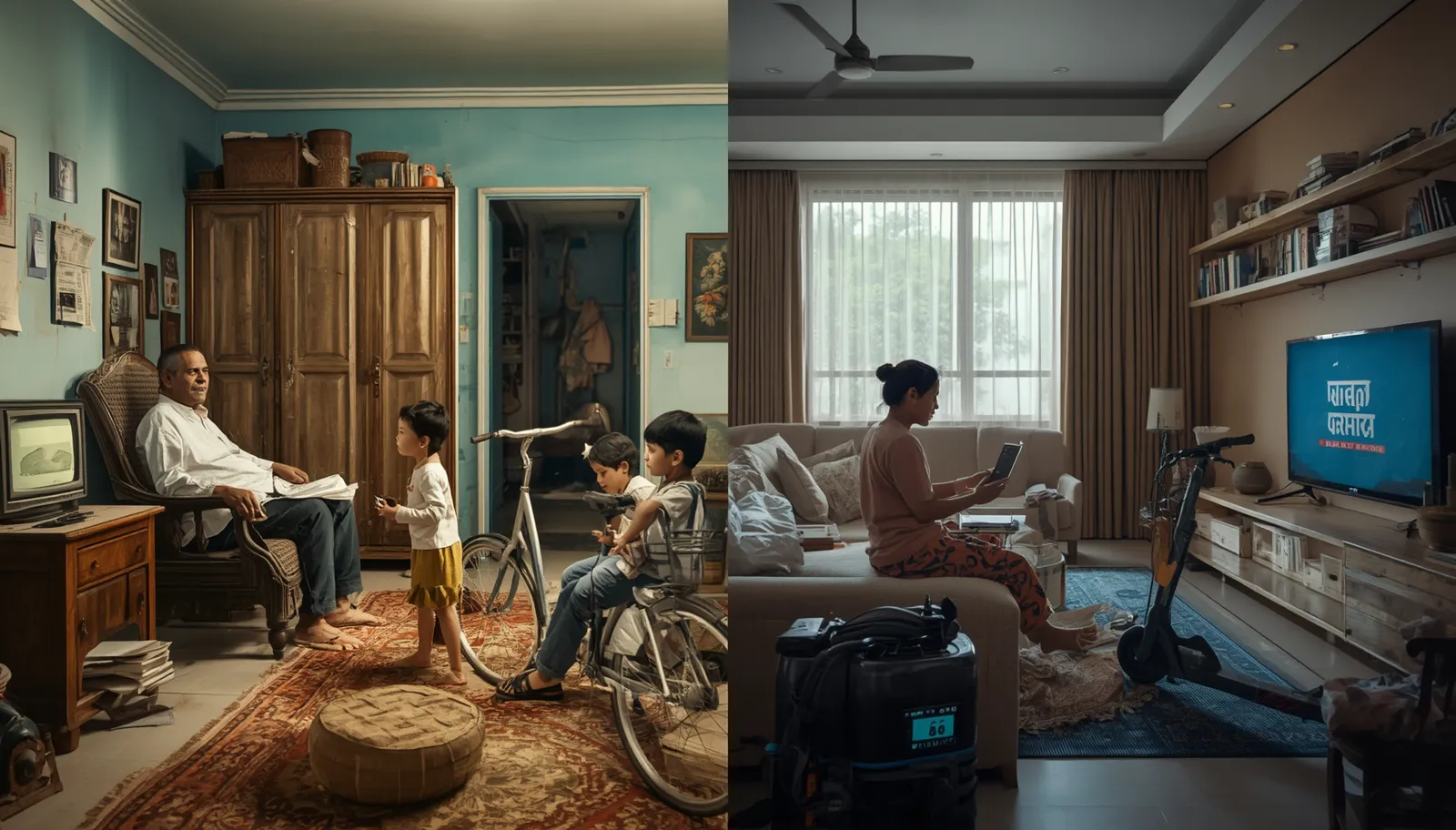
A visual comparison of how everyday life in India has evolved from 1980 to 2026, highlighting changes in communication, family life, technology, work, education, transportation, shopping, and entertainment.
India moved from letters, landlines and appointment television to smartphones, instant payments and on-demand media. Yet the story is not a simple journey from “slow and healthy” to “fast and stressful”—change differs by region, class, gender and generation.
Quick answer: How has Indian lifestyle changed since 1980?
Daily life has become more connected, urban, service-oriented and screen-mediated. Communication is instant, payments are digital, entertainment is on demand, education and work extend online, and consumer choice is wider. At the same time, screen exposure, sedentary work, information overload, privacy risks and blurred work-life boundaries have created new pressures.
Any comparison between 1980 and 2026 must begin with a warning: there was no single Indian lifestyle then, and there is none now. A farming household, a small-town shopkeeper and a metropolitan professional experienced 1980 differently. That diversity remains in 2026.
Better comparison: Treat each period as a range of lived experiences. Technology reached households at different times, and access still does not guarantee equal benefit.
1980 and 2026 at a glance
| Area | Typical experience in 1980 | Common experience in 2026 |
|---|---|---|
| Communication | Letters, telegrams, limited landline access | Smartphones, messaging, video calls and social media |
| Payments | Cash, cheques and in-person banking | UPI, cards, apps and cash together |
| Entertainment | Radio, cinema and limited television | Streaming, gaming, short video and creator media |
| Shopping | Local markets and limited brands | Local shops, malls, quick commerce and e-commerce |
| Work | More paper, fixed locations and manual processes | Digital workflows, platforms, hybrid work and automation |
| Travel | Fewer private vehicles and slower booking | More vehicles, app-based mobility and online booking |
| Information | Newspapers, radio, books and word of mouth | Search, social feeds, video and AI tools |
1. Communication: waiting became instant
In 1980, personal communication often depended on letters, postcards, telegrams and access to a landline. Long-distance calls could be costly or require planning. News from relatives travelled at the speed of the postal or telephone network.
By 2026, a low-cost smartphone can combine calls, camera, map, bank, television, newspaper and office. TRAI reported more than one billion broadband subscriptions in India by late 2025. The gain is obvious: families separated by migration can see each other daily.
The trade-off is permanent reachability. Messages arrive during meals, work and rest. Scam calls, misinformation, harassment and privacy loss are also part of modern communication.
2. Family and social life: connection changed shape
Many households in 1980 organised life around extended family, neighbourhoods, religious institutions, schools and workplaces. Shared spaces and fewer private screens could create more unplanned interaction, although this did not guarantee harmony or personal freedom.
In 2026, migration for education and work has spread families across cities and countries. Video calls preserve contact, while social platforms create communities around hobbies, identity and profession. People can find support beyond geography.
However, digital connection can coexist with loneliness. Family groups may exchange messages all day while members in the same room look at separate screens.
3. The home: from manual routines to connected convenience
Household work in 1980 was more physically demanding where appliances and reliable utilities were limited. Refrigeration, washing machines, mixers, gas connections, water supply and television were not equally available.
By 2026, appliances, delivery services and digital payments reduce time spent on many tasks for households that can afford them. Food, medicines, transport and repairs can be arranged through a phone.
Convenience is not evenly distributed, and unpaid domestic labour remains gendered. Technology can reduce a task without automatically redistributing responsibility.
4. Food: more choice, more processing
Meals in 1980 were often shaped more strongly by local crops, season, household cooking and regional markets. Choice could be limited, and food safety, refrigeration or nutrition access varied widely. Nostalgia should not hide undernutrition or unequal distribution within families.
In 2026, supermarkets, cold chains, restaurants, delivery apps and national brands offer far greater variety. Regional food travels across the country, while international ingredients are easier to obtain.
The same system also makes ultra-processed snacks, sugar-sweetened drinks and large restaurant portions constantly available. Modern India faces multiple nutrition problems at once, including undernutrition, micronutrient deficiency and diet-related chronic disease.
5. Work: from paper files to digital platforms
Many offices in 1980 relied on registers, typewriters, physical files and in-person approvals. Manufacturing, agriculture, trade and government employment were organised without email or cloud systems. A workday was not necessarily easier; manual processes could be slow and hierarchical.
In 2026, email, messaging, cloud software, video meetings, digital marketplaces and AI tools connect work across locations. Remote and hybrid work are possible for some occupations, while delivery, ride-hailing and freelance platforms created new forms of earning.
The boundary between home and work has weakened. Digital monitoring, after-hours messages, insecure platform work and rapid skill change create new forms of stress.
6. Education: scarce information became abundant
Students in 1980 depended heavily on textbooks, teachers, libraries, coaching and broadcast education. Information scarcity could make a good teacher or library especially valuable. Access varied sharply by gender, caste, income, disability and location.
Students in 2026 can use online classes, digital libraries, videos, simulations and AI-assisted tools. A learner in a small town may access lectures from leading institutions.
Information abundance creates a new problem: judging quality. Distraction, copied assignments, misinformation and unequal devices or connectivity can weaken the promised benefit.
7. Money and shopping: the cash economy gained a digital layer
Cash dominated everyday purchases in 1980. Banking required physical visits, paperwork and patience. Consumer choice centred on local stores, ration shops, markets and a smaller range of brands.
In 2026, UPI, cards and mobile banking make small and large transactions immediate. E-commerce and quick commerce compete with neighbourhood shops, while comparison and reviews change buying decisions.
Ease of payment can reduce friction so effectively that spending becomes less visible. Digital fraud, misleading loans, subscription charges and data profiling require new financial literacy.
8. Transport and travel: mobility expanded
Public transport, bicycles, walking and limited private vehicles shaped much of 1980. Booking a railway journey or planning long-distance travel involved in-person information and paper tickets.
By 2026, online booking, navigation, ride-hailing, highways, metro systems and wider vehicle ownership have increased mobility. Travel planning takes minutes, and real-time maps reduce uncertainty.
Growth also brought congestion, air pollution, road injury risk and long commutes. A faster vehicle does not always produce a shorter or calmer journey.
9. Entertainment: from shared schedules to personal feeds
Radio, records, cinema and limited television schedules made entertainment more collective in 1980. People watched or listened at the same time, and scarcity could turn a programme or film into a shared cultural event.
In 2026, streaming platforms, podcasts, gaming, music apps and short videos offer near-infinite choice. Individuals can follow niche creators and watch at any time.
Personalisation also fragments attention. Autoplay and recommendation systems are designed to keep people engaged, making stopping a deliberate skill.
10. Health and healthcare: access and risk both changed
India in 1980 faced major burdens from infectious disease, maternal and child health problems, undernutrition and limited access to specialised care. Healthcare experiences varied enormously by geography and income.
By 2026, diagnostics, medicines, teleconsultation, specialised hospitals and public-health capacity have expanded. People can search symptoms, book tests and access health information quickly.
At the same time, sedentary work, tobacco, air pollution, unhealthy diets, diabetes, cardiovascular disease and mental-health stress demand attention. Online misinformation and self-treatment add another risk.
11. Women’s lives: greater opportunity, uneven freedom
Compared with 1980, more women in 2026 have access to education, professional careers, banking, digital networks and public conversation. Technology can support entrepreneurship, remote work, safety tools and communities.
Progress remains uneven. Unpaid care work, workplace inequality, online abuse, mobility restrictions and safety concerns continue. A smartphone can expand access without removing social barriers.
12. Childhood: more tools, less unsupervised space
Many children in 1980 spent more leisure time outdoors or in mixed-age neighbourhood groups because digital entertainment did not exist. But childhood also included fewer educational resources, less recognition of learning differences and uneven healthcare.
Children in 2026 have interactive learning, global media and instant communication, but also face screen overuse, online safety risks, advertising and academic pressure. The challenge is not to recreate 1980; it is to preserve play, sleep, movement and real relationships inside modern life.
A typical day: illustrative, not universal
| Moment | 1980 illustration | 2026 illustration |
|---|---|---|
| Morning | Radio/newsprint, household chores, local commute | Phone alarm, notifications, app-based commute |
| Work or school | Paper notes, physical files, in-person instruction | Cloud documents, messaging, digital classrooms |
| Shopping | Local market with cash | Local shop, mall or delivery app with UPI |
| Communication | Letter, planned call or face-to-face visit | Continuous messaging and video calls |
| Evening | Neighbourhood activity, radio or scheduled TV | Streaming, gaming, social feeds and video calls |
Was life better in 1980 or 2026?
There is no honest one-word answer. 1980 may represent slower communication, more repair and fewer screens, but it also involved less access to information, services and choice for many people. 2026 offers convenience, connection and opportunity, but also more digital pressure, consumption and sedentary time.
Worth preserving
Repair, local relationships, shared time and slower attention.
Worth keeping
Medical progress, education access, digital payments and communication.
Worth reducing
Pollution, discrimination, preventable disease and information scarcity.
Worth redesigning
Screen habits, work boundaries, consumption and urban mobility.
How to combine the best of both eras
- Use digital payments and tools, but review spending weekly.
- Keep one screen-free shared meal each day where possible.
- Walk for short local journeys when safe.
- Repair or reuse before replacing useful items.
- Schedule focused time without notifications.
- Use online learning, then practise the skill offline.
- Maintain local relationships alongside digital communities.
- Protect sleep from late-night streaming and work messages.
- Verify health and news claims before sharing.
- Choose convenience intentionally instead of automatically.
Limits of this comparison
This article compares broad patterns, not every household. Some technologies described as “2026 life” remain inaccessible or undesirable to many people. Some habits associated with 1980 continued for decades and remain today.
Statistics on subscriptions, households and internet use measure access, not the quality, affordability or purpose of use. Memory also favours emotionally meaningful moments and may understate past inconvenience or inequality.
The bottom line
The biggest 1980 vs 2026 lifestyle changes in India are the rise of digital connectivity, faster services, greater consumer choice and the movement of work, learning, payments and entertainment onto screens.
The useful question is not which year wins. It is which older habits deserve protection and which modern tools improve life without taking over attention, health or relationships.
Related guides: work-life balance tips, mindfulness for beginners, how to sleep better and the value of a degree in 2026.
Frequently asked questions
What is the biggest lifestyle change in India since 1980?
The spread of digital connectivity has transformed communication, payments, work, learning, shopping and entertainment at the same time.
Was life healthier in India in 1980?
Not universally. Some people moved more and ate fewer processed foods, but infectious disease, undernutrition and limited healthcare access were larger problems.
How has family life changed?
Migration and smaller households changed daily interaction, while messaging and video calls help families remain connected across distance.
How has food changed since 1980?
Choice, refrigeration, restaurants and delivery expanded, alongside wider availability of ultra-processed foods and larger portions.
How has work changed?
Paper and location-bound processes increasingly gave way to digital workflows, platforms, automation and some remote or hybrid work.
What older habits are still useful?
Repairing items, shared meals, local relationships, walking and periods of undistracted attention remain valuable.
Is the digital divide over in 2026?
No. Access, affordability, skills, language, disability and quality of connection still shape who benefits.
Sources and further reading
- Telecom Regulatory Authority of India: Current telecom dashboard
- TRAI: Broadband subscriptions crossed one billion
- World Bank: Individuals using the internet in India
- MoSPI: Time Use in India 2024
Method note: The comparisons describe broad social and technological patterns. Individual experiences vary substantially across India.
About the Author