Mehak
Mehak 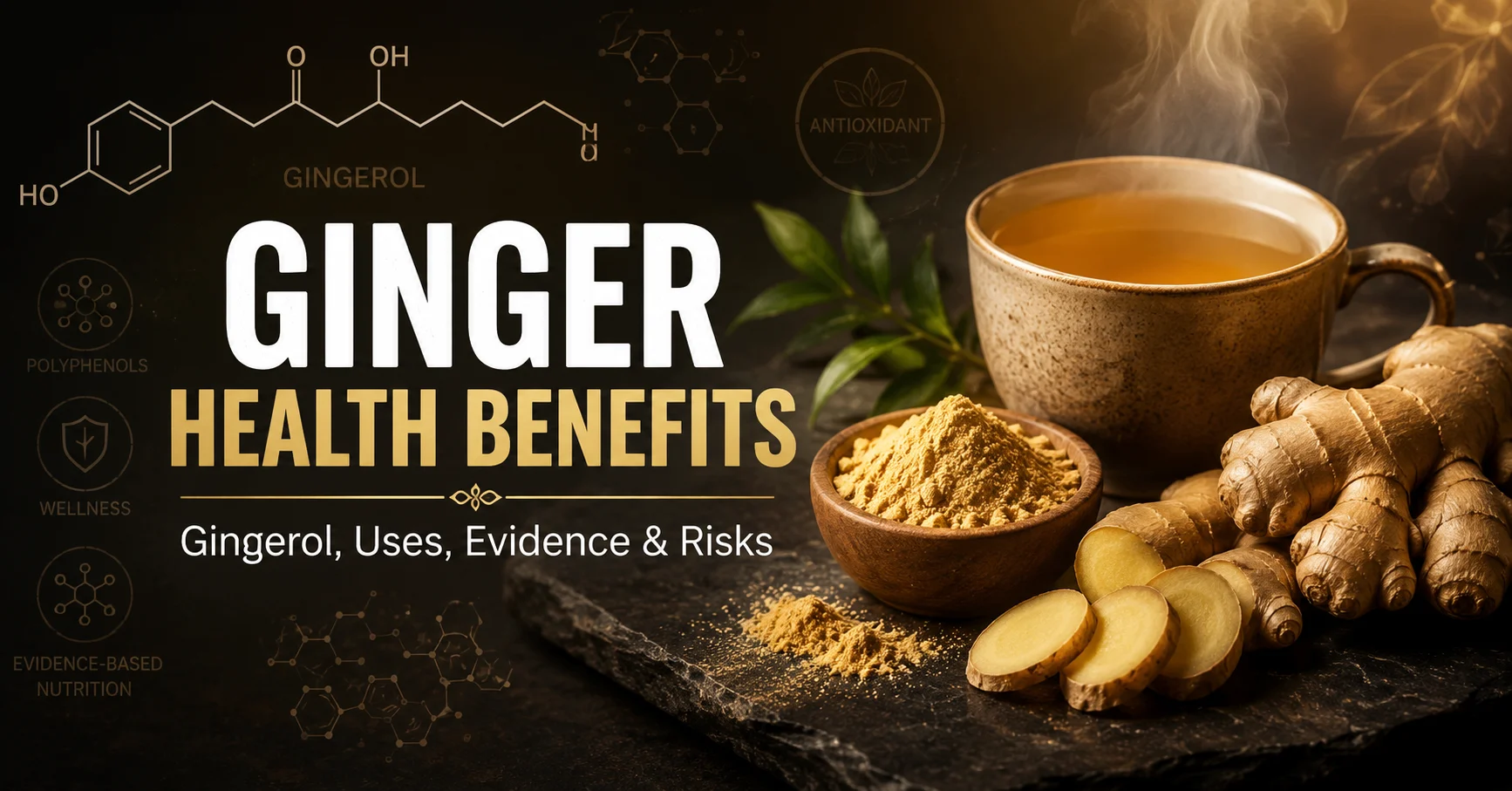
Fresh ginger, ginger tea, and ginger powder presented in a premium editorial design highlighting gingerol, evidence-based nutrition, potential health benefits, common uses, and safety considerations.
Researchers connect several ginger health benefits with natural compounds such as gingerol and shogaol. Human studies support a few uses, particularly some forms of nausea and menstrual pain. However, many popular claims remain uncertain.
Quick answer: What are the main ginger health benefits?
Research suggests ginger may help reduce pregnancy-related nausea, ease the severity of menstrual cramps and modestly improve some knee osteoarthritis symptoms. Evidence for motion sickness, post-surgery nausea, chemotherapy-related nausea, weight loss and disease prevention is less certain. Ginger can also cause heartburn, abdominal discomfort or diarrhoea and may interact with medicines.
Ginger is the underground stem, or rhizome, of Zingiber officinale. People use it fresh, dried, powdered, pickled and in concentrated supplements. Several bioactive compounds create its sharp aroma and warming taste.
Not every ginger product is equivalent. A slice in food or tea differs from a standardised extract used in a clinical trial. Therefore, readers should not automatically apply supplement-study findings to a cup of ginger water.
How to read this guide: “May help” means human evidence suggests a possible benefit. It does not mean ginger cures the condition, works for everyone or should replace appropriate medical care.
What is gingerol?
Gingerol is a family of pungent compounds found prominently in fresh ginger. Researchers have studied 6-gingerol most often. Drying or heating converts some gingerols into related compounds called shogaols. Ginger also contains paradols, zingerone and aromatic oils.
Laboratory research shows that these compounds can influence antioxidant and inflammatory pathways. These observations help scientists form hypotheses, but activity in cells or animals does not prove a clinical benefit in people.
Gingerol benefits: what the science can support
Discussions of gingerol benefits often blend laboratory mechanisms with clinical outcomes. Human trials usually test whole ginger powder or extracts containing several compounds, not isolated gingerol alone. It is therefore more accurate to discuss the health effects of studied ginger preparations while explaining gingerol’s possible role.
| Claim | Evidence summary | Confidence |
|---|---|---|
| Pregnancy-related nausea | Research suggests ginger may help some people; professional guidance remains important. | Promising |
| Menstrual cramps | Supplements might reduce pain severity, although formulations and studies vary. | Promising |
| Knee osteoarthritis | Some symptom improvement is possible, but much of the research is low quality. | Limited |
| Motion sickness | Most studies have not shown a reliable benefit. | Not supported |
| Chemotherapy nausea | It is uncertain whether ginger adds meaningful benefit to standard treatment. | Uncertain |
| Weight loss | Research does not justify treating ginger as a stand-alone weight-loss solution. | Uncertain |
Ginger health benefits supported by human research
Pregnancy-related nausea
NCCIH reports that ginger may help nausea and vomiting associated with pregnancy. Pregnant people should still discuss supplements with their healthcare professional.
Menstrual cramps
Research suggests ginger supplements might reduce cramp severity. It should not delay evaluation of severe, new or disabling pelvic pain.
Knee osteoarthritis symptoms
Oral supplements might provide modest symptom relief for some people. Study quality is inconsistent, and topical ginger has not shown the same evidence.
Flavour without much sodium
Fresh ginger adds strong flavour to soups, vegetables, tea and marinades. This culinary benefit can make balanced meals more appealing without promising a medical effect.
Ginger for nausea and vomiting
Nausea has many causes, so researchers assess each condition separately. Ginger may help pregnancy-related nausea. Most studies have not found it reliably helpful for motion sickness. Evidence remains uncertain for nausea after surgery or during chemotherapy.
People receiving chemotherapy or preparing for an operation should speak to their clinical team before adding concentrated supplements. They should continue standard anti-nausea treatment unless their clinician recommends a change.
Ginger for menstrual cramps
Systematic reviews suggest oral ginger preparations may reduce pain in primary dysmenorrhea. Still, products, amounts and study methods differ. Seek assessment if pain becomes severe, suddenly worsens, causes fainting, occurs between periods or accompanies unusually heavy bleeding.
Ginger for knee osteoarthritis
Some studies report improvements in knee pain or function with oral ginger supplements, but NCCIH notes that much of this research is poor quality. Consider ginger only as a possible complementary option. Do not use it to replace exercise therapy, weight management when relevant, medication or clinical care.
Gingerol benefits: laboratory findings versus human evidence
Researchers often explain potential gingerol health benefits through antioxidant and anti-inflammatory mechanisms. In experiments, gingerol and related compounds can affect signalling molecules involved in oxidative stress and inflammation.
However, a compound can behave differently after digestion, absorption and metabolism. The concentration used in a laboratory dish may not be achievable through food. Human outcomes depend on the preparation, dose, health condition and study quality.
Therefore, well-designed human trials must establish the most credible gingerol benefits. Laboratory antioxidant activity alone cannot prove a meaningful result in people.
For this reason, writers should not turn “contains antioxidants” into “prevents cancer,” “detoxes the liver” or “cures inflammation.” Those conclusions go beyond the evidence.
Popular ginger claims that need more evidence
Weight loss and metabolism
Some trials have studied ginger in metabolic health, but results do not establish it as a reliable fat-burning treatment. A ginger drink may be useful when it replaces a sugary beverage, yet the calorie difference—not a detox effect—is the practical mechanism.
Immunity
Ginger contains biologically active compounds, but no food guarantees protection from infections. Vaccination, sleep, adequate nutrition, hygiene and appropriate medical care remain more important.
Cancer prevention or treatment
Laboratory studies of gingerol do not show that eating ginger prevents or treats cancer in humans. People undergoing cancer treatment should discuss supplements with their oncology team.
Digestive “detox”
Traditional practices use ginger for digestive discomfort, but vague detox claims do not describe measurable medical outcomes. Ginger may also worsen heartburn or irritate the digestive tract in some people.
Ginger health benefits by form: fresh, dried or supplements
| Form | Typical use | What to remember |
|---|---|---|
| Fresh ginger | Cooking, tea, soups and marinades | Provides gingerols in a food-level preparation. |
| Dried ginger | Spice blends, baking and tea | Drying changes the relative amounts of gingerols and shogaols. |
| Ginger tea | Flavoured beverage | Strength varies and should not be equated with a clinical-trial extract. |
| Powder or capsules | Concentrated supplement use | Check the label; products and doses are not interchangeable. |
| Standardised extract | Research or supplement products | May contain a controlled concentration not achievable in food. |
There is no single universally appropriate ginger dose for every purpose. Trial amounts vary, and stronger products can increase side effects. Use the product label and seek professional advice for therapeutic supplement use.
How to get ginger health benefits through your diet
You do not need a concentrated supplement to include ginger in a balanced routine. Many people can explore ginger health benefits through modest culinary amounts while avoiding the stronger exposure and greater uncertainty associated with high-dose products.
- Grate fresh ginger into lentils, vegetables or soup.
- Add thin slices to hot water for a mild unsweetened drink.
- Use ginger with garlic and spices in marinades.
- Stir a small amount into oatmeal or a smoothie.
- Choose unsweetened ginger tea instead of sugary packaged drinks.
- Avoid assuming that a stronger or more pungent serving is healthier.
Simple ginger tea
- 250 ml water
- 2–3 thin slices of fresh ginger
- Optional: lemon wedge for flavour
- Bring the water to a gentle boil.
- Add the ginger and simmer for 5–8 minutes.
- Strain and allow it to cool to a comfortable temperature.
Note: This is a culinary drink, not a standardised treatment dose. Lemon may aggravate reflux, and honey adds sugar.
Ginger side effects and safety
Many oral research studies have used ginger without serious problems, but “natural” does not mean risk-free. NCCIH lists possible effects including:
- Abdominal discomfort
- Heartburn
- Diarrhoea
- Mouth or throat irritation
Stop or reduce use if symptoms repeatedly follow ginger. Seek urgent medical help for signs of a serious allergic reaction, such as breathing difficulty or swelling.
Medicine interaction warning: If you take prescription medicine, use multiple supplements, are preparing for surgery, are pregnant or breastfeeding, or have a significant medical condition, consult a qualified healthcare professional before using concentrated ginger products.
Who should ask a healthcare professional first?
- People who take medicines that could interact with herbal products
- Anyone considering high-dose or concentrated ginger supplements
- Pregnant people using ginger specifically for nausea
- People who are breastfeeding, because safety data are limited
- People preparing for surgery or a medical procedure
- Anyone with persistent nausea, pain, bleeding or unexplained digestive symptoms
Persistent symptoms deserve evaluation. Nausea can signal pregnancy, infection, migraine, medication effects or another condition. Joint pain and menstrual pain also have many possible causes.
Ginger health benefits: the final evidence-based verdict
The best-supported ginger health benefits relate to pregnancy-associated nausea, menstrual cramps and possibly knee osteoarthritis symptoms. Evidence quality and product forms vary, so no result comes with a guarantee.
Gingerol helps explain some of ginger’s biological activity, but laboratory mechanisms do not prove that ginger treats disease. Culinary ginger can be a flavourful part of a varied diet. Concentrated supplements deserve more caution.
Practical takeaway: Use ginger as food first. Treat supplements as active products, check for interactions and do not replace prescribed care with a home remedy.
Frequently asked questions
What are the main ginger health benefits?
Human research suggests ginger may help pregnancy-related nausea, menstrual-cramp severity and some knee osteoarthritis symptoms. Evidence for many other claims is uncertain.
What is gingerol?
Gingerol is a group of pungent compounds found mainly in fresh ginger. 6-Gingerol is the most studied. Heating and drying can convert some gingerols into related shogaols.
What are gingerol benefits?
Gingerol shows antioxidant and inflammation-related activity in laboratory research. Most human studies test whole ginger preparations, so researchers cannot always separate isolated gingerol benefits from the effects of other compounds.
Can ginger help with nausea?
It may help pregnancy-associated nausea. Evidence for motion sickness, chemotherapy-related nausea and post-surgery nausea is less convincing or uncertain.
Can I consume ginger every day?
Many people tolerate culinary amounts. Daily concentrated supplements are different and may cause heartburn, diarrhoea or interactions. Ask a professional if you take medicine or have a health condition.
Is fresh ginger better than ginger powder?
They contain different proportions of gingerols and shogaols. Neither is universally better; the appropriate form depends on the recipe or studied use.
Does ginger burn belly fat?
Ginger is not a proven stand-alone fat-burning treatment. Weight change depends on longer-term diet, activity, sleep, health and medication factors.
Who should avoid ginger supplements?
People taking medicine, preparing for surgery, pregnant or breastfeeding, or managing significant health conditions should seek personalised guidance before using concentrated products.
Sources and further reading
- NCCIH: Ginger—Usefulness and Safety
- Nutrients: Therapeutic health effects of ginger
- Critical review of ginger antioxidant and anti-inflammatory evidence
- NIH Office of Dietary Supplements: Botanical resources
Medical note: This article provides general education and does not replace diagnosis, treatment or advice from a qualified healthcare professional.
About the Author