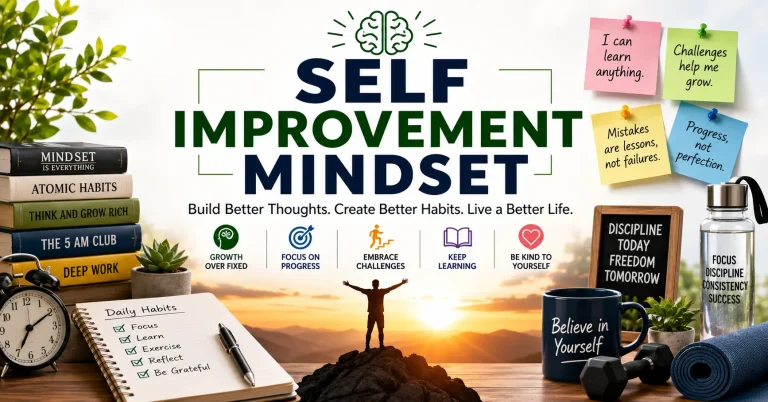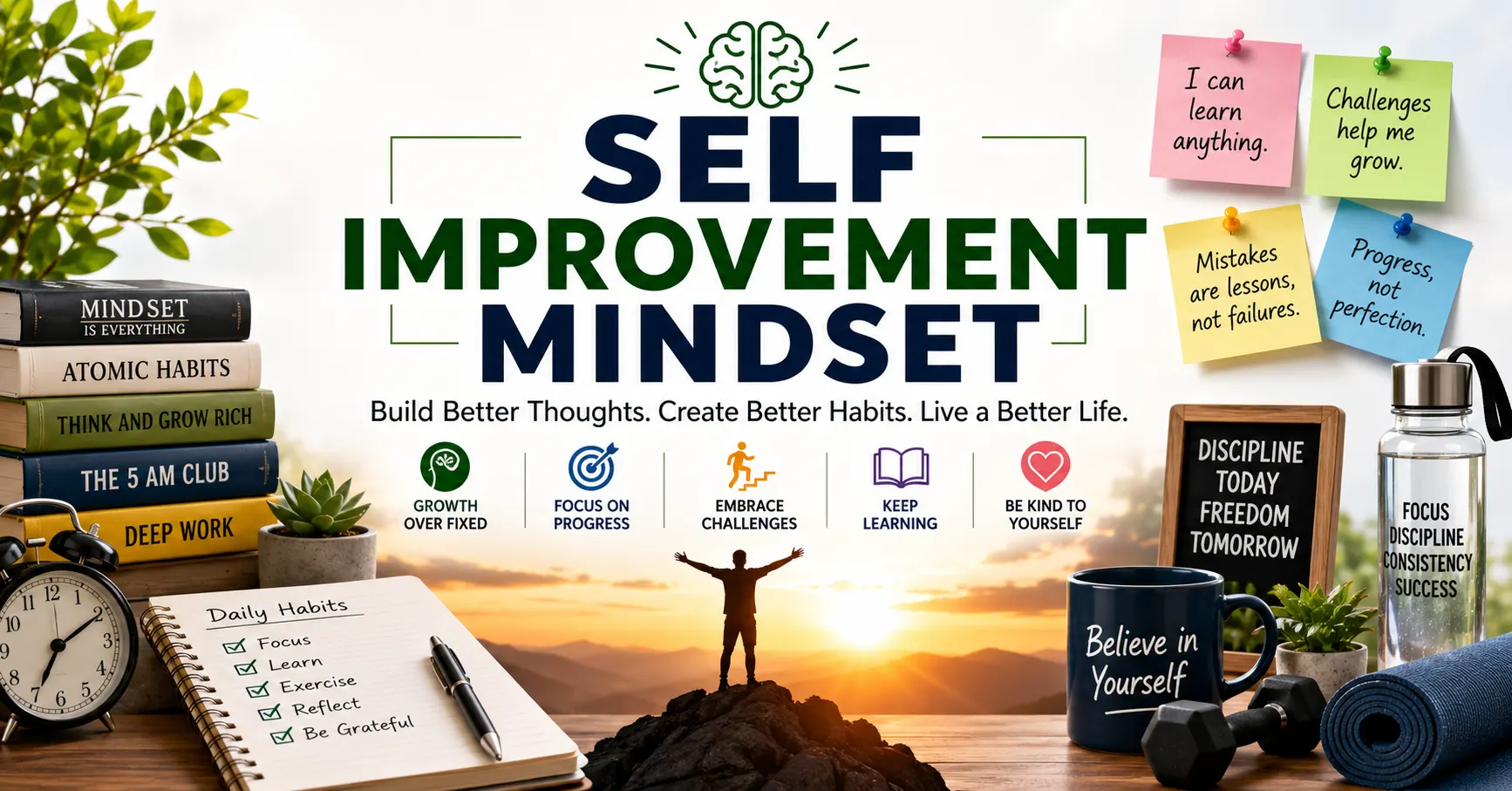
Develop a self improvement mindset through positive habits, continuous learning, resilience, and daily actions that support personal growth and success.
Most people who feel “stuck” aren’t actually lacking skills, intelligence, or opportunity — they’re operating from a mindset that quietly limits what they believe is possible for them. Building a genuine self improvement mindset isn’t about positive thinking slogans or forcing yourself to feel motivated all the time. It’s about understanding how your thoughts shape your actions, identifying the specific beliefs holding you back, and deliberately practicing new patterns of thinking until they become natural. This guide breaks down the psychology and practical steps behind real, lasting personal growth.
Understanding a Self Improvement Mindset
A self improvement mindset is the underlying belief that your abilities, intelligence, and circumstances are not fixed — they can be developed through effort, strategy, and learning from setbacks. This concept, often called a “growth mindset” in psychological research, contrasts with a “fixed mindset,” where people believe their talents and traits are largely set in stone.
The difference matters enormously in daily life. People with a growth-oriented mindset tend to interpret failure as useful feedback rather than proof of inadequacy. They seek out challenges instead of avoiding them, and they persist longer when things get difficult, because setbacks feel like information rather than identity-confirming evidence of being “not good enough.”
Self Improvement Mindset and Limiting Beliefs
1. Notice Your Internal Language
Pay attention to phrases like “I’m just not good at this,” “I’ve always been this way,” or “That’s not who I am.” These statements often feel like neutral facts, but they’re usually beliefs formed long ago that have simply gone unquestioned since.
2. Separate Facts From Interpretations
“I failed the presentation” is a fact. “I’m bad at public speaking and always will be” is an interpretation built on top of that fact. Learning to separate the two creates space to choose a more useful interpretation — “I need more practice with presentations” — without denying what actually happened.
3. Trace Beliefs Back to Their Origin
Many limiting beliefs were formed in childhood or from a single painful experience, then generalized into a permanent rule about yourself. Asking “where did I first start believing this?” often reveals that the belief was based on a narrow, outdated experience rather than an accurate, current truth.
4. Test Beliefs Against Evidence
Once a belief is identified, look honestly for counter-evidence. If you believe “I always give up on things,” can you find even small examples where you followed through? Most limiting beliefs collapse at least partially under honest scrutiny.
Self Improvement Mindset Strategies for Building Resilience
5. Treat Setbacks as Data, Not Verdicts
A failed attempt provides specific, useful information about what didn’t work — not a final judgment on your worth or potential. Reframing “I failed” into “that approach didn’t work, here’s what I learned” keeps you in a problem-solving mindset rather than a self-critical one.
6. Use the “Yet” Reframe
Adding the word “yet” to a limiting statement — “I’m not good at this yet” instead of “I’m not good at this” — keeps the door open for growth rather than closing it with a permanent label.
7. Separate Self-Worth From Performance
Tying your entire sense of worth to outcomes (a promotion, a grade, a relationship) creates fragile self-esteem that collapses with every setback. Building self-worth around effort, character, and values instead provides a more stable foundation that doesn’t depend on constant external success.
8. Practice Self-Compassion Instead of Harsh Self-Criticism
Research consistently shows that self-compassion — treating yourself with the same kindness you’d offer a friend after a mistake — leads to better motivation and resilience than harsh self-criticism, which often triggers avoidance and shame rather than productive change.
Self Improvement Mindset Habits for Better Self-Discipline
9. Reduce Friction for Good Habits
Willpower is a limited resource that fluctuates throughout the day. Rather than relying on it constantly, design your environment to make good choices easier — keeping a book visible instead of buried, preparing workout clothes the night before, removing tempting distractions from your workspace.
10. Use Identity-Based Goals
Instead of framing goals purely around outcomes (“I want to write a book”), frame them around identity (“I am someone who writes daily”). Identity-based framing tends to produce more consistent behavior, because each small action reinforces a self-concept rather than just chasing a distant outcome.
11. Start Ridiculously Small
Committing to “read one page” or “do one push-up” feels almost too easy to skip, which is exactly the point. Small commitments build consistency, and consistency — even at a small scale — compounds into significant change over time, far more reliably than ambitious goals that get abandoned after a few days.
12. Track Progress Visually
A simple habit tracker, journal, or calendar where you mark off each day a habit is completed creates visible momentum. Seeing a growing streak provides motivation that’s hard to generate through willpower alone.
How a Self Improvement Mindset Helps You Embrace Challenges
13. Ask “What Can I Learn Here?” Before Judging Outcomes
When something doesn’t go as planned, the immediate instinct is often self-judgment. Pausing to ask what specifically can be learned shifts the experience from purely emotional to constructively useful.
14. Seek Feedback Actively, Not Just When Forced To
Many people avoid feedback because it feels uncomfortable, but actively seeking it — asking a mentor, colleague, or friend for honest input — accelerates growth far faster than waiting for feedback to arrive unprompted, often after a mistake has already compounded.
15. Get Comfortable Being a Beginner Again
Adults often avoid trying new things specifically because being a beginner feels uncomfortable or embarrassing. Deliberately practicing new skills — even unrelated to your career, like a new hobby — builds tolerance for the discomfort of not being immediately good at something, which transfers to other areas of growth.
16. Surround Yourself With Growth-Oriented People
Mindset is contagious. Spending time around people who view challenges as opportunities for growth, rather than threats to avoid, reinforces the same orientation in your own thinking over time.
Self Improvement Mindset Techniques for Managing Self-Criticism
17. Name the Inner Critic as Separate From Yourself
Many people experience a harsh internal voice that feels like absolute truth. Recognizing this voice as a pattern of thought — not an objective narrator — creates psychological distance, making it easier to question rather than automatically believe.
18. Challenge All-or-Nothing Thinking
Phrases like “I always mess this up” or “I never follow through” are rarely literally true. Replacing absolute language with more accurate, specific language (“I struggled with this particular task this week”) reduces the emotional weight of self-criticism.
19. Write a Letter to Yourself From a Compassionate Perspective
When stuck in self-critical thinking, writing out what you’d say to a close friend in the same situation — then reading it back to yourself — often reveals a much kinder, more reasonable perspective than your immediate internal reaction.
Self Improvement Mindset Goal-Setting Strategies
20. Focus on Process Goals, Not Just Outcome Goals
Outcome goals (“get promoted”) are largely outside your direct control. Process goals (“deliver high-quality work consistently, ask for feedback monthly”) are within your control and, over time, increase the likelihood of the outcome you want without making your sense of progress dependent on external validation.
21. Review and Adjust Goals Regularly
Goals set months ago may no longer reflect your current priorities or circumstances. Revisiting goals periodically — monthly or quarterly — and adjusting them keeps your growth efforts aligned with what genuinely matters to you now, rather than what mattered when you first set the goal.
22. Celebrate Small Wins Along the Way
Waiting until a large goal is fully achieved before acknowledging progress can make the journey feel discouraging. Recognizing small milestones along the way sustains motivation over the long stretches between major achievements.
Building Self-Awareness Through a Self Improvement Mindset
23. Journal Regularly, Even Briefly
Writing even a few sentences daily about what happened, how you felt, and what you noticed about your own reactions builds self-awareness over time, revealing patterns that are difficult to see in the moment.
24. Reflect on Triggers, Not Just Reactions
Instead of only noticing how you reacted to a frustrating situation, examine what specifically triggered that reaction. Understanding your triggers makes it possible to respond more intentionally the next time a similar situation arises.
25. Periodically Ask: “Is This Belief Still Serving Me?”
Beliefs and habits that once protected or helped you can become outdated as your circumstances change. Periodically questioning whether a long-held belief still serves your current goals and values keeps your mindset evolving alongside your life.
Common Obstacles to a Self Improvement Mindset
Fear of Failure
Fear of failure often stems from tying self-worth too closely to outcomes. Reframing failure as informative rather than identity-defining, and practicing smaller, lower-stakes attempts first, gradually reduces this fear’s grip over time.
Comparison to Others
Constant comparison — amplified heavily by social media — distorts your sense of progress, since you’re usually comparing your full, unfiltered reality to someone else’s curated highlights. Tracking your own progress against your past self, rather than against others, provides a far more accurate and motivating comparison.
Impatience With Slow Progress
Meaningful personal growth is often invisible day-to-day and only becomes clear in retrospect over months or years. Trusting the process during the invisible middle stretch, rather than expecting immediate, visible transformation, is essential for staying consistent long enough to see real change.
Self-Improvement Mindset FAQs
Can a fixed mindset really change into a growth mindset?
Yes. Mindset is a pattern of thinking, not a fixed trait, and research shows it can shift with deliberate practice — particularly by noticing fixed-mindset thoughts in real time and consciously reframing them.
How do I stay motivated when progress feels slow?
Shift focus from the distant outcome to the process itself, track small wins regularly, and remind yourself that slow, invisible progress is still progress. Motivation built on visible streaks and process goals tends to be more durable than motivation built purely on anticipated future results.
Is a Self Improvement Mindset Different From Perfectionism?
No — a healthy self improvement mindset includes self-acceptance alongside growth. The goal isn’t constant dissatisfaction, but a balanced view that you are worthy as you are now, while also genuinely capable of continued growth.
A self improvement mindset isn’t built through occasional bursts of motivation — it’s built through consistent, small shifts in how you interpret setbacks, talk to yourself, and approach new challenges. Start by noticing one limiting belief this week and gently questioning whether it’s actually still true. That single habit of self-reflection is often the first real step toward lasting personal growth.
To continue building a well-rounded approach to personal growth, explore our related posts on productivity tips for getting more done without burnout and health and wellness habits for a stronger, calmer life.
- 📌 How to Build Self Confidence: Daily Habits & Science
- 📌 How to Build Self-Discipline: Daily Habits & Practical Tips
About the Author