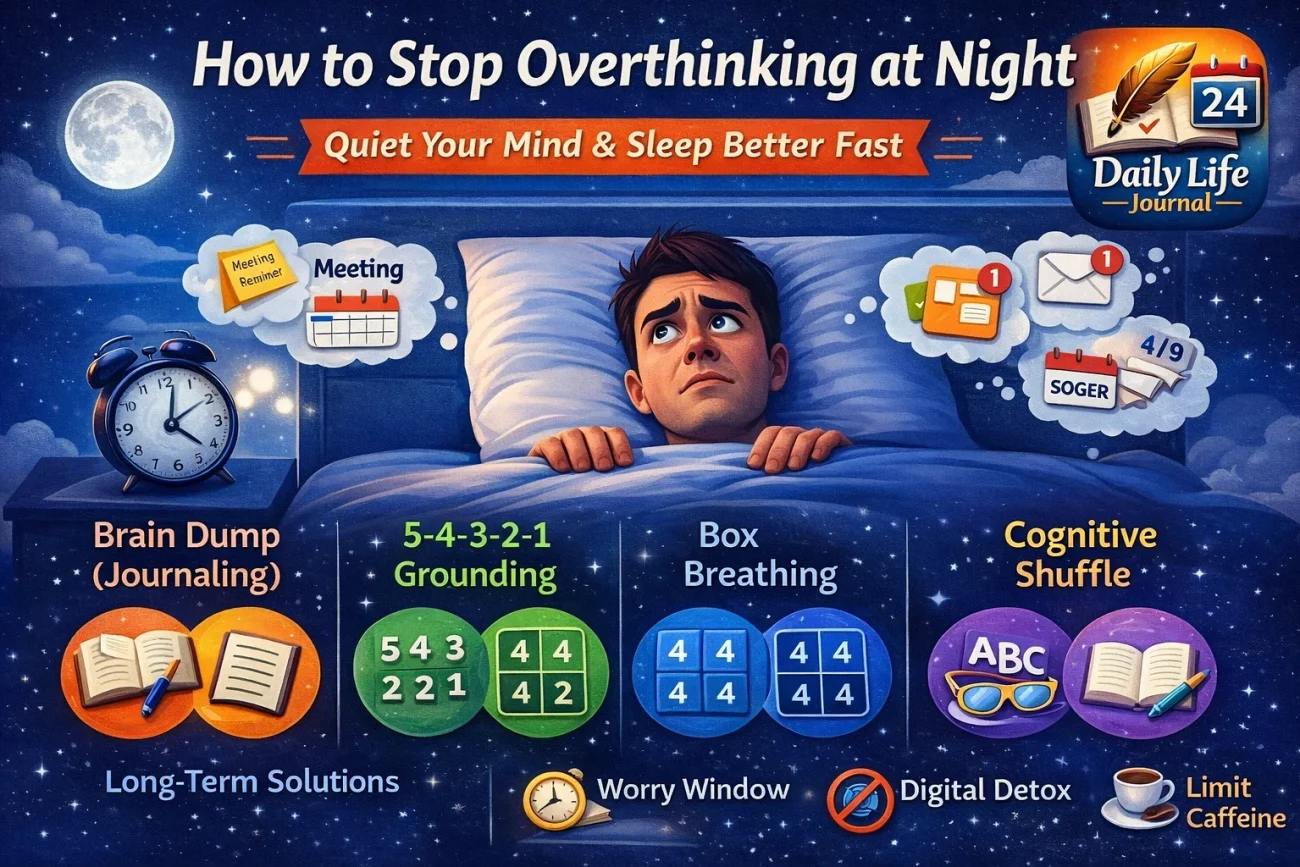
You’ve had a long day. You’re exhausted. You finally lay down in your bed, turn off the lights, and close your eyes. But the moment the room goes silent, your brain wakes up. Suddenly, you remember an embarrassing mistake you made three years ago. You start worrying about a meeting tomorrow. You wonder why that one person didn’t reply to your text.
If this sounds familiar, you are not alone. Overthinking at night (often called “Nighttime Rumination”) is a common struggle for millions of people. When the distractions of the day disappear, our brain finally has the space to process every unsolved problem and every hidden fear.
But constant overthinking doesn’t just keep you awake; it affects your mental health, your productivity the next day, and your overall quality of life. In this detailed guide, we will explore why this happens and provide you with actionable, science-backed techniques to shut down the noise and reclaim your sleep.
Why Do We Overthink Specifically at Night? (The Science Behind the Noise)
To solve the problem, we first need to understand why it happens. Why is our brain “quiet” during the day but “loud” at 2 AM?
1. Lack of Distractions
During the day, your brain is occupied with work, talking to people, scrolling through social media, and doing chores. This is called “active engagement.” However, when you lie in bed in a dark, quiet room, there is zero external stimulation. Your brain, which is designed to solve problems, starts looking for something to work on—and it finds your worries.
2. The Cortisol and Melatonin Balance
Normally, our cortisol (stress hormone) levels should be low at night, and melatonin (sleep hormone) should be high. However, if you are chronically stressed, your cortisol levels remain elevated. This keeps your brain in a state of “Hyperarousal,” meaning you are physically tired but mentally wired.
3. The “Safety” of the Night
Ironically, some people overthink at night because it feels like a “safe space” to process emotions. Since you don’t have to “pretend” to be okay for the world, your subconscious mind brings all the suppressed emotions of the day to the surface.
The Vicious Cycle of Overthinking and Insomnia
Overthinking creates a dangerous loop: Overthinking $\rightarrow$ Anxiety $\rightarrow$ Physical Tension $\rightarrow$ Inability to Sleep $\rightarrow$ Frustration $\rightarrow$ More Overthinking.
When you can’t sleep, you start worrying about the fact that you aren’t sleeping. You think, “If I don’t sleep now, I’ll be exhausted tomorrow, I’ll perform poorly at work, and my boss will be angry.” This creates a second layer of anxiety, making it almost impossible to drift off.
Immediate Techniques to Stop Overthinking (The “Right Now” Solutions)
If you are lying in bed right now and your mind is racing, try these four techniques immediately:
1. The “Brain Dump” Technique (Journaling)
Since your website is DailyLifeJournal.in, this is the most important tip! Overthinking happens because your brain is afraid you will forget something important. It keeps “looping” the thought to remind you.
- How to do it: Get out of bed, take a notebook, and write down every single thing worrying you. Don’t worry about grammar or making sense. Just “dump” the thoughts from your head onto the paper.
- Why it works: Once a thought is written down, your brain receives a signal that the information is “stored” and safe. It no longer needs to loop the thought, allowing you to relax.
2. The 5-4-3-2-1 Grounding Method
This is a powerful psychological tool to pull you out of your head and back into your body.
- 5 things you can see: Look around the room (even in the dark) and identify 5 objects.
- 4 things you can touch: Feel the texture of your blanket, your pillow, your pajamas, or your own skin.
- 3 things you can hear: Listen for the hum of the AC, the sound of distant traffic, or your own breathing.
- 2 things you can smell: Notice the scent of your pillow or the air in the room.
- 1 thing you can taste: Notice the taste in your mouth.
- Why it works: Overthinking is a “future” or “past” activity. Grounding forces your brain to return to the “present moment.”
3. Box Breathing (The Navy SEAL Method)
When you overthink, your breathing becomes shallow, which tells your brain you are in danger. Box breathing reverses this.
- Inhale for 4 seconds.
- Hold the breath for 4 seconds.
- Exhale slowly for 4 seconds.
- Hold empty for 4 seconds.
- Repeat 4 times.
- Why it works: This physically hacks your nervous system, switching you from “Fight or Flight” mode to “Rest and Digest” mode.
4. The “Cognitive Shuffle” (Mental Word Games)
If your brain is stuck on a worry, give it a task that is boring but requires just enough focus to distract it.
- How to do it: Pick a random word (e.g., “BEDTIME”). Now, imagine as many objects as possible that start with ‘B’ (Ball, Bear, Boat…), then ‘E’ (Egg, Elephant, Eagle…), and so on.
- Why it works: It mimics the “random” nature of dreams, which tricks your brain into thinking it is already entering the sleep phase.
Long-Term Lifestyle Changes to Prevent Nighttime Anxiety
If you want to stop overthinking permanently, you need to change your daily habits.
1. Create a “Worry Window”
Instead of worrying at 2 AM, schedule your worrying for 5 PM.
- The Rule: Set a timer for 15 minutes every evening. During this time, allow yourself to worry as much as you want. Write down the problems and potential solutions.
- The Result: When a worry pops up at night, tell yourself: “I have already dealt with this during my Worry Window, or I will deal with it tomorrow at 5 PM.”
2. Digital Detox (The Blue Light Problem)
Scrolling through Instagram or news feeds before bed is like pouring gasoline on the fire of overthinking.
- The Science: The blue light from screens suppresses melatonin. More importantly, social media provides “Comparison Triggers”—you see someone’s perfect life and start overthinking your own failures.
- The Solution: Turn off all screens 60 minutes before sleep. Read a physical book or listen to a calming podcast instead.
3. Limit Caffeine and Sugar
Caffeine has a half-life of about 5-6 hours. If you drink coffee at 4 PM, half of it is still in your system at 10 PM. This keeps your brain alert and more prone to anxiety. Try to stop caffeine intake by 2 PM.
4. Optimize Your Sleep Environment
Your brain associates your bed with sleep. If you lie in bed for hours overthinking, your brain starts associating the bed with stress.
- The 20-Minute Rule: If you haven’t fallen asleep in 20 minutes, get out of bed. Go to another room, do something boring in dim light (like folding laundry), and return to bed only when you feel sleepy.
When Should You Seek Professional Help?
While overthinking is common, sometimes it is a symptom of something deeper, such as Generalized Anxiety Disorder (GAD) or Clinical Depression. You should consider talking to a therapist or doctor if:
- Your overthinking prevents you from functioning during the day.
- You experience physical symptoms like heart palpitations, chest pain, or severe panic attacks.
- You find yourself unable to experience joy, even when you aren’t overthinking.
- You are using alcohol or medication to force yourself to sleep.
Remember, seeking help is a sign of strength, not weakness. A professional can provide you with Cognitive Behavioral Therapy (CBT) to permanently rewire how you process stress.
Final Thoughts: Be Kind to Your Mind
Overthinking is not a flaw in your personality; it is often a sign that you are a deeply caring and analytical person. The goal is not to “kill” your thoughts, but to learn how to manage them.
Start tonight. Put away your phone, take a deep breath, and if the thoughts come, simply acknowledge them: “Oh, there is that thought again. I see it, but I don’t need to solve it right now.”
Your only job at night is to rest. The world will still be there tomorrow, and you will be much better equipped to handle it after a good night’s sleep.
Also read: Best Morning Routine for Productivity
Check this guide: How to Reduce Stress Naturally
According to research by Sleep Foundation, stress and overthinking are major causes of insomnia.
